

A simple, step-by-step guide to protecting your container plants from slugs with hand-picking, smart pot placement and simple traps, plus the truth about copper tape and eggshells.
You step onto your patio in the morning and find your basil, lettuce or hostas full of ragged holes. There’s a shiny, silvery trail across the pot and the deck. But you don’t see a single bug.
The culprit is almost certainly a slug. Slugs feed mostly at night and hide during the day, so the damage often appears before you ever see one. The University of Kentucky notes that slugs are common pests during wet weather and can damage many types of plants.
The good news is that potted plants are easier to protect than garden beds. You can move them, raise them and check under them. And you don’t need harsh slug poisons. University experts agree that slugs are best managed with a mix of methods, not a single magic fix. As a University of California entomologist put it, one way just doesn’t work.
In this guide you will learn:
- How slugs live, and why they love pots and patios
- How to tell slug damage apart from other pests
- How to find and hand-pick slugs
- How to set up pots so slugs have fewer places to hide
- How to make safe beer and yeast traps
- What a big scientific trial found about copper tape, eggshells and grit
- When to consider a low-toxicity bait, and how to use it safely
- A 4-week plan to clean up and track your progress
Know Your Enemy: How Slugs Live
Slugs are soft-bodied animals related to snails, but without a shell. They move on a layer of slime, which protects their bodies and leaves the shiny trails you see in the morning.
Here’s what matters for your potted plants:
| Fact | What it means for you |
| Slugs feed mainly at night (University of Kentucky) | Damage appears overnight; look for them after dark |
| They need moisture and are worst in wet weather | Damp pots, saucers and decks attract them |
| They hide in cool, dark, damp places by day | Under pots, pot rims, saucers, boards and dense plants |
| They’re attracted to yeasty, fermenting smells (University of Minnesota) | That’s why beer and yeast traps work |
| Their thick slime protects them | They can glide over rough surfaces that seem like barriers |
Why pots help (a lot)
In 2018, the Royal Horticultural Society (RHS), the UK’s leading gardening charity, ran a careful trial with 108 lettuces in pots and raised beds. One clear result surprised many people: where the lettuces were planted made a huge difference.
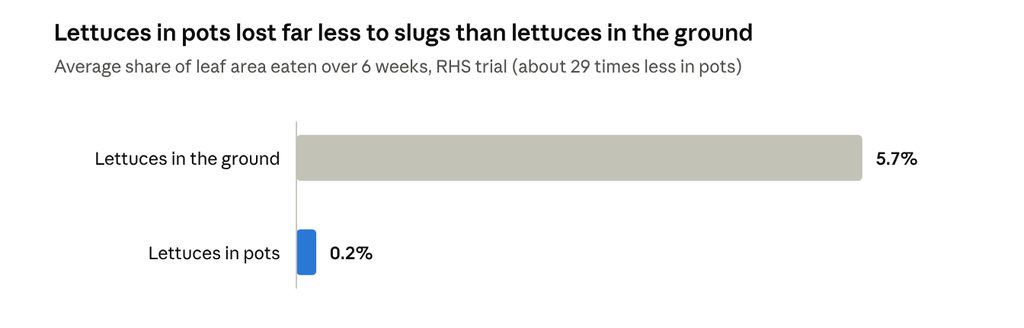
Source: Royal Horticultural Society (UK) Gastropod Barriers trial, 2018, as reported by BBC News. 108 lettuces at RHS Wisley; pots also gave a smaller harvest. One site and one season.
Lettuces in pots had only 0.2% of their leaf area eaten on average, compared with 5.7% for lettuces in the ground. Pots did produce a smaller harvest, but they were far less damaged. This was one trial at one site, but it supports what many gardeners notice: raising plants off the ground makes life harder for slugs.
That’s good news for container gardeners. You’re already starting with an advantage. The steps below help you keep it.
Is It Really Slugs? Check First
Several pests chew holes in leaves. Here’s how to tell them apart.
| Clue | Slugs or snails | Caterpillars | Earwigs | Flea beetles |
| Holes | Ragged holes, often in the middle of leaves; can eat whole seedlings | Ragged holes and chewed edges | Ragged holes, often in tender growth and flowers | Many tiny round “shot holes” |
| Slime trails | Yes, shiny silver trails | No | No | No |
| Droppings | Small slimy pellets | Green or dark pellets on leaves | Rarely seen | Rarely seen |
| When they feed | Night and rainy days | Day and night | Night | Day |
| How to confirm | Check with a flashlight after dark | Look under leaves in daytime | Check at night or under rolled-up newspaper | See tiny jumping beetles |
If you see slime trails and damage that appears overnight, it’s slugs or snails. Most of this guide works for snails too.
Step 1: Go on a Night Patrol and Hand-Pick
Hand-picking sounds simple, and it is. It’s also one of the most recommended methods. The RHS suggests going out in the evening to hand-pick slugs. The University of Maine says an hour spent hand-picking can noticeably reduce the population.
How to do it
- Go out after dark. Marin County’s agriculture department says the best time is after 10 or 11 pm, when slugs are most active. On rainy evenings they may come out earlier.
- Bring a flashlight and gloves. Slime is sticky and hard to wash off.
- Check plants, pot rims, saucers and the ground around your pots.
- Pick them off and drop them into a bucket of soapy water, as a University of California entomologist suggests. Or move them far away from your plants.
- Repeat nightly at first. Marin County advises collecting nightly until slugs are hard to find, then checking once a week.
This is free, uses no pesticides, and is very effective on a patio, where your pots are all in one place.
Step 2: Take Away Their Daytime Hiding Spots
Slugs spend the day in cool, dark, damp places. On a patio or balcony, the best hiding spots are often your pots themselves.
| Hiding spot | What to do |
| Under pots sitting flat on the ground | Raise pots on pot feet, bricks or a plant stand |
| Inside saucers | Empty saucers after watering; wipe them out |
| Under pot rims and lips | Check and scrape off slugs when you water |
| Drainage holes | Check the bottom of the pot; a piece of mesh over the hole can help keep them out |
| Dense, droopy leaves touching the ground | Trim back leaves that touch the deck or soil |
| Boards, bricks, and stored pots lying around | Marin County advises removing boards and pots you aren’t using as traps |
| Thick mulch or leaf litter around pots | Rake it away; Kentucky suggests raking leaves and mulch so the ground can dry |
| Ivy and dense ground covers next to the patio | Marin County notes slugs find these very attractive; trim them back from pots |
Water in the morning, not the evening
Slugs need moisture and come out at night. If you water in the morning, the soil surface, pot and patio have time to dry before dark. Evening watering leaves everything wet just when slugs start moving. This is a habit, not a strict rule: if a pot is wilting on a hot afternoon, water it. Just water at the base of the plant and keep the patio around it as dry as you can.
Step 3: Set Simple, Safe Traps
Traps let slugs come to you. Two kinds work well for potted plants.
Hiding traps (boards, pots and rinds)
Slugs look for shelter at dawn. You can give them a shelter that you control.
- What to use: The University of Connecticut says pieces of board, old shingles, and half grapefruit or melon rinds work. The University of Arizona suggests overturned unglazed flower pots, placed on the shady side of the plant.
- How: Set them on the ground near your pots in the evening. Prop one edge up slightly, or place them on uneven ground so slugs can crawl under.
- Each morning: Lift the trap and remove the slugs hiding underneath.
Beer or yeast traps
The University of Minnesota says slugs are attracted to fermentation, so they crawl into the beer and drown. UConn notes that research has shown beer can be used to control slugs, with nonalcoholic beer having a slight edge, and that sugar water mixed with yeast works too.
How to make one:
- Use a shallow container, like a cottage cheese or yogurt tub.
- For a patio, set it on the ground between pots. In a garden bed, sink it so the rim is just above soil level (UConn), so beetles and other helpful bugs are less likely to fall in.
- Fill it partway with beer. Or mix warm water, a spoonful of sugar and a pinch of yeast.
- Put it out in the early evening.
- Empty and refill it every few days. The University of Kentucky says beer should be changed every few days to stay effective.
Pet tip: Dogs may want to drink the beer. UConn suggests a covered container with holes cut in the sides, buried up to the holes. Keep traps away from children too.
The RHS notes that beer traps haven’t yet been tested in its own trials, but several U.S. extension services recommend them.
Step 4: Set Up Pots So Slugs Struggle
Since the RHS trial showed pots get much less damage, make the most of that advantage.
- Raise pots off the ground on feet, stands or shelves. This removes the dark, damp space underneath.
- Keep pots away from walls, fences and dense plants that slugs use as highways.
- Use hanging baskets or tall planters for your most slug-loved plants, like lettuce, basil, hostas and young seedlings.
- Clean pot bottoms and saucers every week or two.
- Check new plants for slugs and eggs (small, clear, jelly-like balls in the soil) before bringing them home.
- Start seedlings indoors and move them out once they’re bigger and tougher.
Step 5: If You Need a Bait, Choose the Lower-Risk Kind
For many container gardeners, hand-picking, hiding traps and beer traps are enough. If slugs are still a big problem, some people use a slug bait. Here’s what to know.
| Bait ingredient | What experts say | Cautions |
| Iron phosphate (e.g., Sluggo, Escar-Go) | Marin County calls it safer for children and pets than metaldehyde. Slugs stop feeding and die in 3 to 6 days. Arizona says it may be used around vegetables but works better on snails than slugs. | Still a pesticide; keep out of reach of kids and pets. The University of Alaska notes some bait forms contain added chelates that can poison animals. Read the label. |
| Ferric sodium EDTA | Works like iron phosphate but faster (University of Alaska) | Still a pesticide; keep out of reach of kids and pets. EDTA is the kind of added chelate the University of Alaska warns can poison animals, so read the label carefully |
| Metaldehyde | Effective but poses a greater risk to pets and wildlife | Not recommended for a natural approach |
If you use any bait:
- Follow the label exactly.
- Use the smallest amount that works, scattered thinly, not in piles.
- Keep it away from pets and children. The University of Kentucky warns some slug baits can be toxic to people, pets and wildlife.
- Don’t let pellets touch the leaves of edible plants (University of Kentucky).
- Consider putting bait inside a trap to limit access by other animals, as the University of Arizona suggests.
The RHS takes an even more cautious view: it advises against slug pellets, even organic ones, because of possible effects on garden wildlife, and recommends encouraging natural predators and other methods instead.
Copper Tape, Eggshells and Grit: What the Science Says
These are some of the most popular natural slug remedies. The RHS put five of them to the test in its 2018 trial.
The result: copper tape, sharp horticultural grit, pine bark mulch, wool pellets and crushed eggshells made no difference. Slugs and snails did the same amount of damage to protected lettuces as to unprotected ones. The RHS researchers suggested that slugs’ thick slime acts as a protective shield, letting them glide over rough or sharp barriers.
To be fair, the RHS also said that some lab studies have shown certain barriers work, and that other experiments hinted copper tape could be effective. So the honest answer is: barriers are unreliable. Don’t count on them alone.
| Remedy | What we know | Our advice |
| Hand-picking at night | Recommended by the RHS, University of Maine, Marin County | Yes, the best free method |
| Removing hiding spots | Recommended by Kentucky, Marin County, UC | Yes |
| Raising pots / growing in containers | RHS trial: far less damage in pots | Yes |
| Hiding traps (boards, rinds, pots) | Recommended by UConn, Arizona, Minnesota | Yes |
| Beer or yeast traps | Recommended by Kentucky, UConn, Minnesota | Yes, with pet care |
| Copper tape around pots | No difference in the RHS trial; some other studies suggest it may help | Optional; don’t rely on it |
| Crushed eggshells | No difference in the RHS trial | Skip it for slugs (fine in compost) |
| Sharp grit | No difference in the RHS trial | Skip it |
| Wool pellets, pine bark | No slug difference in RHS trial, but did act as fertilizer and mulch | Fine for plant health, not for slugs |
| Coffee grounds | We found no good evidence for slug control | Don’t rely on it |
| Salt | Arizona warns it raises soil salinity, which harms plants | Never put salt on soil or pots |
| Essential oil sprays | Some commercial sprays use them; little good evidence for pots; can harm pets, especially cats and birds | Skip them |
Encourage Natural Predators
The RHS recommends encouraging natural predators. Many animals eat slugs, including birds, toads, frogs, ground beetles and some snakes.
- Avoid broad-spectrum bug sprays that kill helpful ground beetles.
- Add a small water feature or birdbath for birds and toads. (Change the water weekly so it doesn’t breed mosquitoes!)
- Leave a bit of wild space away from your patio, where predators can live.
Step 6: Habits That Keep Slugs Away
- Water in the morning, not the evening.
- Raise pots off the ground.
- Empty saucers after watering.
- Check under pots and rims once a week.
- Do a quick flashlight check after rainy evenings.
- Keep the patio clear of boards, leaves and unused pots.
- Trim plants that droop onto the ground.
- Keep a beer or hiding trap out during damp seasons.
- Protect seedlings by starting them indoors or in raised containers.
Your 4-Week Cleanup and Check Plan
Why 4 weeks? Slugs keep arriving from nearby gardens, and damp weather brings new waves. Four weeks of steady effort lets you clear the slugs around your pots, set up traps and build habits. It is not a guarantee. In wet seasons, you’ll need to keep checking.
| When | What to do | Time needed |
| Week 1, nights 1 to 3 | Hand-pick after dark each night. | 15 minutes a night |
| Week 1, day 1 | Raise pots, empty saucers, clear boards and leaves, trim plants touching the ground. | 1 hour |
| Week 1, day 2 | Set hiding traps and beer or yeast traps. | 20 minutes |
| Week 2 | Check traps each morning. Hand-pick every other night. Refresh beer every few days. Switch to morning watering. | 10 minutes a day |
| Week 3 | Check traps. Hand-pick twice a week. Look for new damage. | 10 minutes |
| Week 4 | Few or no slugs in traps and little new damage is a very good sign. Keep weekly checks during damp weather. | 15 minutes a week |
What you’re seeing and what it means
| What you see by Week 4 | What it means | What to do |
| Few slugs, little new damage | Your plan is working | Keep weekly checks |
| Still many slugs in traps | They’re moving in from nearby | Keep trapping; clear nearby hiding spots; raise pots higher |
| Damage on one plant only | That plant is a favorite | Move it to a hanging basket or higher shelf |
| Heavy damage despite everything | Very wet season or large population nearby | Consider an iron phosphate bait, used carefully |
Common Myths About Slugs
| Myth | The truth |
| “Copper tape stops slugs.” | It made no difference in the RHS trial. It may help in some cases, but don’t rely on it. |
| “Crushed eggshells keep slugs away.” | No difference in the RHS trial. Slime protects slugs from sharp edges. |
| “Salt is a natural slug killer.” | Salt harms soil and plants. The University of Arizona warns against it. |
| “Natural slug pellets are totally safe.” | Even iron phosphate baits are pesticides. Keep them from pets and kids, and read the label. |
| “If I don’t see slugs, they aren’t there.” | They hide by day. Check after dark. |
| “Watering in the evening is fine.” | Evening watering keeps things wet when slugs come out. Water in the morning. |
Quick Answers to Common Questions
Are slugs dangerous to touch? They’re not poisonous, but their slime is sticky and they can carry germs. Wear gloves and wash your hands after handling them or anything they’ve crawled on. Wash any garden produce well before eating.
Will slugs climb into hanging baskets? They can climb, but baskets are much harder to reach. Check the chains and the basket rim now and then.
Why do slugs keep coming back every year? Slugs live in gardens, lawns, hedges and damp corners all around your home, and new ones move in from nearby. The University of Alaska notes that slugs causing damage are often migrating in from a population elsewhere. That’s why regular checks matter more than a one-time cleanup.
What should I do during a rainy week? Rain brings slugs out in force. During wet spells: hand-pick every evening, check traps every morning, empty saucers after each rain, and move your most valuable or tender plants up onto a table, shelf or hanging hook until the weather dries.
Can I put slugs in my compost? It’s better not to add live slugs to compost, since they may simply crawl back out into your garden. Dispose of them in the trash or move them far from your plants.
Is it okay to use eggshells anyway? They’re fine in compost or as a soil amendment, but don’t expect them to stop slugs.
What about kids and pets? Hand-picking, hiding traps and pot changes are kid- and pet-friendly. Cover beer traps so pets can’t drink from them. Keep any slug bait out of reach, and follow the label.
When should I call for help? If slugs keep destroying plants after a month of steady effort, a local extension office or master gardener program can help identify the species and suggest next steps for your area.
The Bottom Line
Slugs are sneaky night feeders, but potted plants give you a real advantage. Raise your pots, take away their hiding spots, water in the morning, hand-pick at night, and use simple beer or hiding traps. Skip the salt, and don’t rely on copper tape or eggshells, since a major trial found they made no difference.
That’s what experts recommend, and the main steps use no pesticides at all. If you ever add a slug bait, read the label and keep it away from kids, pets and wildlife. Give it about four weeks of steady effort, and keep checking during wet weather.
Sources
- Royal Horticultural Society: How to stop slugs and snails: what works?
- BBC News coverage of the RHS trial, via NewsSniffer: Slug deterrents trial results
- University of Kentucky Entomology: Slugs, ENTFACT-407
- University of Connecticut Extension: Slugs and Snails
- University of Arizona Cooperative Extension: Snails and Slugs, Bulletin #59
- Marin County Department of Agriculture: Slugs and Snails
- University of Alaska Fairbanks: Invasive Slugs, Module 3: Monitoring and Control
- Bangor Daily News, quoting University of Maine, University of Minnesota and University of California experts: Protect your garden from slugs
- ASPCA Animal Poison Control Center: Essential oils and pets

